
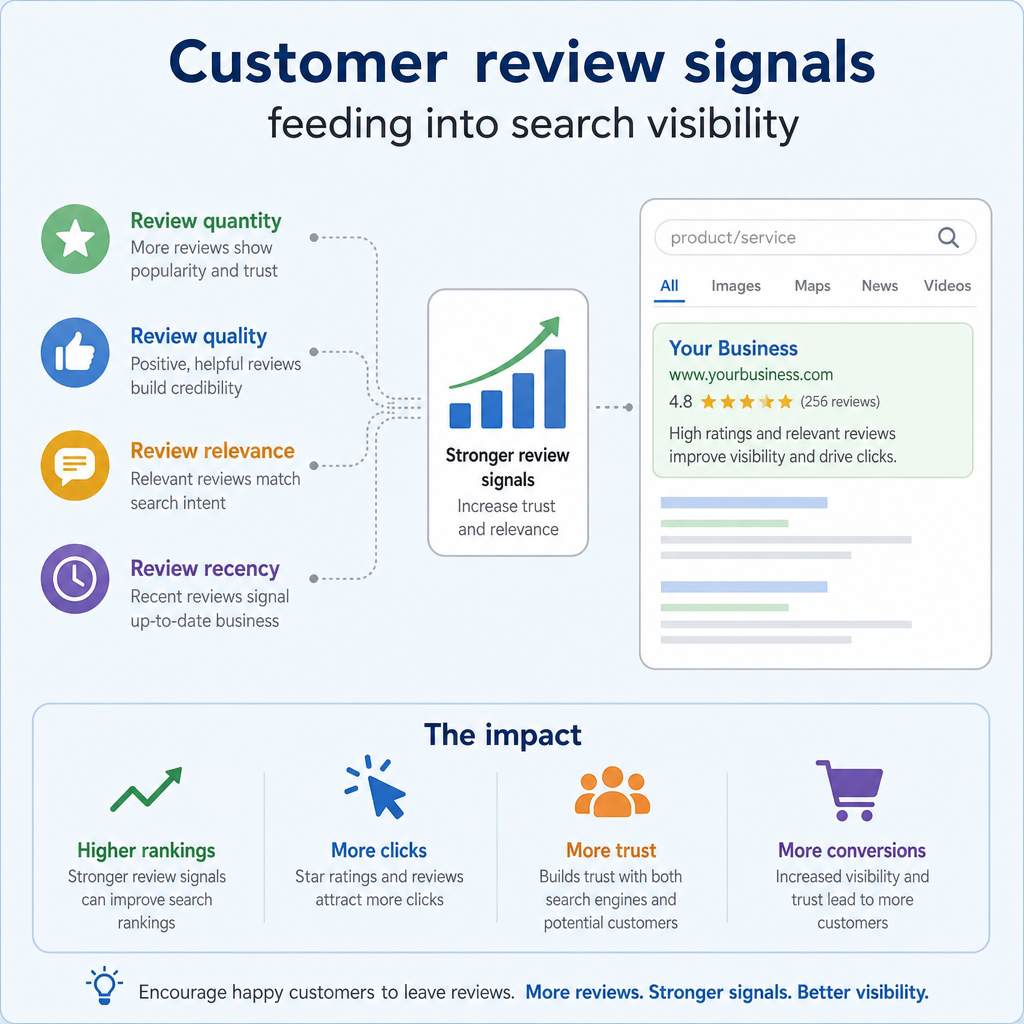
Customer reviews now do much more than reassure people at the point of purchase. They act like public trust signals that search engines, review sites and AI-led discovery tools can interpret when deciding which businesses look credible, relevant and active. Backlinks still matter, but for many brands, especially local and service-based businesses, reviews have become one of the clearest ways to prove reputation in the open.
Why are reviews starting to behave like backlinks?
Reviews are starting to behave like backlinks because they point back to your business with context, sentiment and lived customer experience. A backlink says another website acknowledges you; a review says a real customer interacted with you, judged the experience, and left searchable evidence. That makes reviews as backlinks a useful way to think about modern authority: not as a technical replacement for links, but as a broader reputation signal.
Traditional backlinks can still show expertise, especially when they come from respected publications, industry bodies or local partners. The problem is that many link-building tactics have become noisy, thin or transactional. Reviews, by contrast, are attached to specific services, locations, staff interactions, product experiences and customer outcomes.
That detail matters. A review mentioning “quick emergency plumbing repair in Bristol” or “friendly dental check-up for nervous patients” provides search engines with more practical context than a generic directory link. It can help connect your business with the language customers actually use when searching.
What makes reviews powerful for SEO?
Reviews are powerful for SEO because they combine freshness, relevance, trust, and conversion impact into a single public asset. Good SEO reviews do not simply improve how your brand looks; they can also strengthen the signals about what you offer, where you operate, and how customers describe your value.
Reviews are particularly helpful for a number of reasons: Freshness: Recent reviews indicate that a business is still active and serving its customers.
Volume: The more reviews that come in consistently, the more established the profile looks compared to a few old comments.
Specificity: Reviews with services, problems solved, and locations are useful semantic details.
Good patterns build trust. Thoughtful responses to criticism show accountability.
Distribution: Extend your reputation footprint beyond your website by being cited on relevant review sites.
This is why review generation should not be treated as a small customer service task. It belongs within your broader search, content, and reputation strategy. If your backlink profile says you are known, your reviews show how people experience working with you.
Reviews and backlinks work best together
It is tempting to frame reviews and backlinks as rivals, but the smarter approach is to let them support each other. Good backlinks help you reach new audiences and build your domain authority. Strong reviews, in turn, help those audiences decide whether to trust you.
Imagine two local businesses with similar websites. You have some old reviews and some low-value directory links. The other has fewer backlinks, but recent reviews across trusted review sites, helpful owner responses and customer comments that match common search queries. The second business often looks more alive, more relevant and more reassuring to a prospective buyer.
That does not mean you should abandon link building. It means you should be selective. A mention from a respected local newspaper, trade association, event sponsor page or specialist blog can still be valuable. But chasing dozens of weak links while ignoring customer feedback is a waste of time.
A practical review strategy for stronger visibility
The best review strategies are simple, repeatable and respectful. They do not rely on awkward pressure or incentives. They build the review request into natural customer moments, when satisfaction is fresh, and the next step feels easy.
The practical workflow is: Ask for it at the opportune moment. Ask for a review when a service is finished, a delivery is successful, a support issue is resolved or a positive comment is received from a customer.
1. Be specific in your ask. Ask customers to say what they bought, what problem was solved or what they liked.
2. Reduce friction. Do not send instructions; keep it short and send a direct link to the review profile.
3. Answer quickly. Respond to concerns calmly and practically, and thank happy customers.
4. Search for themes. Improve website copy, service pages, and local content by removing review-repeated phrases.
5. Share carefully. Use good review snippets on your site or social channels as appropriate – but don’t over-edit the meaning of the customer.
It turns reviews from passive feedback to an active reputation asset. It also helps your team learn what customers value most, which can help shape landing pages, blog topics and sales conversations.
How do businesses scale their review responses?
Even if the reviews are negative or short, it’s important for businesses to respond consistently and thoughtfully. A good response lets someone know that you’re listening, reinforces your brand voice and gives prospective customers one more reason to trust you. The challenge is that manual replies can become time-consuming as review volume grows.
This is where a tool such as ReplyPro can support the process. ReplyPro is presented as a Review Auto-Reply SaaS product, designed for businesses and teams that need help managing responses to customer reviews more efficiently. (replypro.digitalxgrowth.com) For owners, marketers, local operators and reputation teams, that kind of automation can help keep replies timely without letting review management swallow the working day.
The main benefits are practical:
1. Time saved by reducing the need to draft every reply from scratch.
2. More consistent tone across responses, especially when several people manage reviews.
3. Faster engagement with customers who have taken the time to leave feedback.
4. Improved workflow discipline as review responses become part of a repeatable process. Improved reputation management with visible & frequent engagement with reviewers.
Automation should still feel human. The best use of review reply software is not to remove judgement, but to handle routine replies more efficiently while leaving room for personalisation, escalation and genuine care. If review responses are becoming a bottleneck, exploring ReplyPro could be a sensible next step.
Blogger outreach still has a place
Backlinks have not disappeared; poor backlink tactics have simply become easier to spot. Blogger outreach can still work when it is targeted, respectful and genuinely useful. The aim is not to blast templates to every website you can find, but to build relationships with people whose audience overlaps with yours.
Especially mid-tier bloggers, niche publishers and local creators can be very useful. They may not have the reach of big publications, but their audiences tend to be more engaged and relevant. A well-thought-out review, product feature, interview or local story can create referral traffic as well as a credible link.
Keep outreach targeted: Select publishers whose audiences would actually care about your offer.
1. Make it personal – include why you are contacting them.
2. Give them something useful: expert insight, a demo, data, a sample or a local angle.
3. Don’t spend money on bad links or cheap guest posts with little content.
4. Track outcomes beyond the link, including traffic, enquiries and brand mentions.
When blogger outreach and review generation work together, your brand earns authority from two directions: third-party publishers and real customers.
Turning reviews into a wider trust engine
The real opportunity is to stop treating reviews as isolated stars on a profile. They can inform your content, improve your messaging and highlight objections before prospects speak to you. If several reviews praise speed, clarity or aftercare, those benefits should appear naturally on your service pages.
Negative reviews can also be useful. They can reveal confusing processes, unmet expectations or gaps in communication. Responding well does not erase the issue, but it can show future customers that your business takes problems seriously.
In that sense, reviews are both an SEO asset and an operational feedback loop. They help people find you and make your business easier to choose.
Key takeaway
Reviews are not a direct replacement for backlinks, but they now carry a level of trust, context and commercial influence that no modern SEO strategy should ignore. Strong links can build authority; strong reviews can prove that authority is deserved.
Focus on earning genuine feedback, responding consistently, using trusted review sites and building selective backlinks from sources that actually matter. Do that, and your search visibility will be supported by something far stronger than tactics alone: real customer confidence.
Leave a Reply
Your email address will not be published. Required fields are marked *